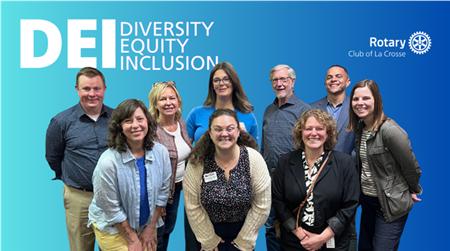
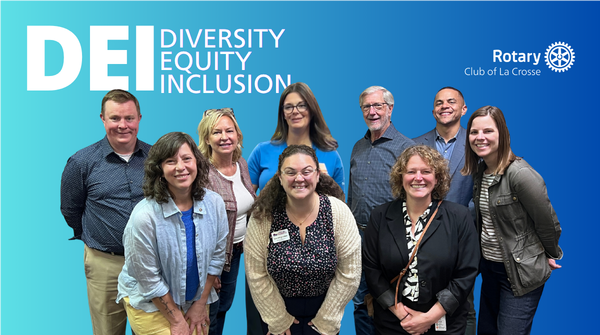
When people ask why Rotary should care about diversity, equity, inclusion, and belonging (DEIB), our answer is simple:
Because Rotary always has.
When Paul Harris founded Rotary in 1905, his vision was to bring together professionals from diverse backgrounds to exchange ideas, build relationships, and create positive change in their communities. Diversity was not an afterthought. It was part of Rotary's origin story. Rotary International continues to reinforce this commitment today through its focus on belonging, engagement, and ensuring that people from all walks of life have a place at the table.
Yet DEIB work is sometimes misunderstood. People worry it means being judged for using the wrong words, getting called out for mistakes, or being expected to know everything. Because this work is so relationship-focused, making someone feel bad is never the goal. At its best, DEIB work creates opportunities for conversation, learning, and service. It recognizes that none of us are perfect and all of us have room to grow.
As Rotarians, we don't need a new test to determine whether this work is worthwhile. We already have one.
Is It the Truth?
The first question of the Four-Way Test asks us to pursue truth.
The truth is that every community contains people with different lived experiences, identities, abilities, cultures, faith traditions, ages, and perspectives. The truth is that some people feel welcomed and connected immediately, while others struggle to find a sense of belonging. The truth is that listening to experiences different from our own helps us better understand the communities we serve.
Truth requires curiosity. It requires the humility to recognize that our experience is not everyone's experience. It requires us to listen more than we speak and learn more than we assume. For Rotary clubs, truth means honestly examining whether everyone who walks through our doors feels invited to participate, contribute, and lead.
Is It Fair to All Concerned?
Equity is often the most misunderstood part of DEIB work, but it aligns beautifully with Rotary's second question.
Fairness does not mean treating every person identically. Fairness means ensuring people have a genuine opportunity to participate and succeed.
Consider a club meeting held in a location that is difficult for someone using a wheelchair to access. Or a service project that unintentionally excludes families with young children. Or a fundraiser that assumes everyone has the same financial flexibility. Equal treatment might mean offering the same experience to everyone. Fairness requires us to ask whether everyone can meaningfully participate in that experience.
This is not about special treatment. It is about removing unnecessary barriers so more people can contribute their talents and gifts.
Will It Build Goodwill and Better Friendships?
Rotary is, at its heart, a relationship organization. Every one of us knows what it feels like to walk into a room where we belong. We also know what it feels like to stand on the outside looking in.
Belonging is not about agreement. It is not about sameness. It is about creating an environment where people feel comfortable pulling up a chair, sharing an idea, asking a sincere question, or volunteering for leadership. It is about ensuring that every member knows they matter.
When we intentionally create spaces where more people feel welcome, we strengthen friendships. We deepen trust. We expand our understanding of one another.
That is exactly what Rotary has always done best.
Will It Be Beneficial to All Concerned?
The final question asks us to consider impact beyond ourselves.
Communities are strongest when everyone can contribute. Organizations are strongest when they benefit from a wide range of perspectives and experiences. Rotary clubs are strongest when they reflect and connect with the communities they serve.
DEIB work helps us reach people we might otherwise miss. It helps us identify barriers we may not see ourselves. It helps us create clubs that are sustainable, welcoming, and relevant for future generations.
Most importantly, it helps us serve more effectively. When we seek to understand the experiences of others, we become better neighbors, better community leaders, and better Rotarians.
The Real Goal
Our Rotary Club's Diversity, Equity, and Inclusion Committee exists for one reason: to help create an environment where every member can thrive.
We are not the "fun police." We are not keeping score. We do not hand out citations for honest mistakes. We are simply Rotarians who care deeply about relationships, belonging, and ensuring that our club remains a place where everyone can show up ass their authentic selves and contribute their unique perspectives and experiences.
In many ways, DEIB work is not something separate from Rotary.
It is Rotary.
It is choosing truth over assumptions.
It is choosing fairness over convenience.
It is choosing goodwill over division.
It is choosing what benefits all concerned over what benefits only ourselves.
When viewed through the lens of the Four-Way Test, diversity, equity, inclusion, and belonging are not modern additions to Rotary's mission. They are a powerful expression of the values Rotary has championed from the very beginning.
And if we want to build vibrant clubs, meaningful friendships, and stronger communities, then this work is not optional. It is part of who we are.