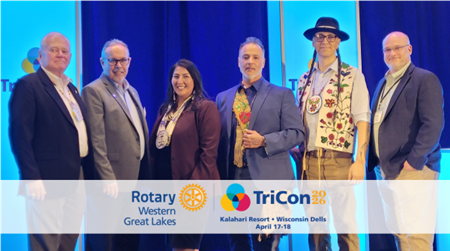
As Rotarians from Districts 6220, 6250, and 6270 gathered at the Kalahari Resort in Wisconsin Dells this past April 17–18, we came together under the banner of "Unite for Good." This year’s TriCon was more than a conference; it was an invitation to deepen our understanding of the communities we served and the neighbors we walked alongside.
In the spirit of building "Goodwill and Better Friendships," we were honored to present a journey into the heart of Wisconsin’s first nations. The exploration, "Ancestors and Arrivals," served as a foundation for our final plenary session.
We heard from Biskakone Greg Johnson (Lac du Flambeau- artist, educator, and cultural practitioner), Samantha Skenadore (Ho-Chunk/Oneida- Attorney for Federal Indian Law and Tribal Law) and Jonathan Greendeer (Ho-Chunk/Oneida- President of the Ho-Chunk Nation). Their insights helped us bridge the gap between history and our modern reality, offering Rotary a unique opportunity to foster lasting impact through cultural humility and shared respect.
To help further our understanding, I want to share with you some historical information about our indigenous neighbors, friends, co-workers and family-
Ancestors and Arrivals: The Distinct Paths of the Ho-Chunk, Oneida Nations, and Lac du Flambeau
Wisconsin’s cultural landscape is shaped by the presence of eleven federally recognized tribes, each with a unique story. However, few contrasts are as striking as those between the Ho-Chunk, the Oneida, and the Lac du Flambeau Band of Lake Superior Chippewa. While one has been rooted in this soil since time immemorial, the others traveled hundreds or even thousands of miles—driven by prophecy or political pressure—to build a new future in the Northwoods and the Fox Valley. Together, these nations represent a spectrum of the Indigenous experience: the original inhabitant, the displaced ally, and the prophetic migrant.
The Ho-Chunk Nation: "People of the Big Voice"
The Ho-Chunk are an autochthonous people, meaning they are original to this land. Their history is not one of arrival, but of enduring presence and a fierce, multi-generational refusal to be erased from their ancestral home.
Ancient Roots
Linked to the Effigy Mounds culture that once dominated the region, the Ho-Chunk's ancestral territory originally spanned southern Wisconsin and parts of Illinois, Iowa, and Minnesota. For the Ho-Chunk, the land is not merely a place they live; it is the source of their identity and the site of their creation.
The "Walkers"
During the 19th century, the U.S. government attempted to forcibly remove the Ho-Chunk to reservations as far away as South Dakota and Nebraska. However, the government underestimated the people’s bond with the Wisconsin landscape. In a stunning display of resistance, many Ho-Chunk—known in history as the "Walkers"—repeatedly escaped their western reservations and walked back to Wisconsin on foot, often in the dead of winter. This cycle of removal and return occurred multiple times until the federal government finally allowed them to take up homesteads in Wisconsin in the late 1800s.
A Unique Geography
This history of resistance created the unique land base the Nation holds today. Unlike many tribes with a single, contiguous reservation, the Ho-Chunk Nation owns land across several Wisconsin counties. This "scattered" geography is a living map of their persistent efforts to reclaim pieces of their ancestral home, parcel by parcel, through sheer willpower and legal acumen.
The Oneida Nation: "People of the Upright Stone"
The Oneida story in Wisconsin is one of migration, strategic survival, and eventual rebirth. Originally a founding member of the Haudenosaunee (Iroquois) Confederacy in present-day New York, they were forced to seek a new home over a thousand miles away in the 1820s.
The Move West
The Oneida were staunch allies to the American colonists during the Revolutionary War, yet their loyalty did not protect them from relentless land speculation and pressure in New York. By the early 19th century, the situation became untenable. Led by spiritual and political leaders, the Oneida negotiated with the Menominee and Ho-Chunk to purchase land near Green Bay. They arrived as a sophisticated, Christianized, and politically savvy nation, determined to preserve their culture in a new environment.
The Land Rebirth
The struggle did not end with their arrival. After losing nearly all their Wisconsin land to federal "Allotment" policies in the late 1800s—which divided communal land into private plots that were often sold to non-Natives—the Oneida Nation was left with only a few hundred acres. Starting in the 1930s, the nation began a massive, multi-decade effort to re-purchase their lost territory.
Economic Powerhouse
Today, that effort has borne fruit. The Oneida Nation is a major economic engine in Northeastern Wisconsin. They maintain a large, contiguous reservation in Outagamie and Brown counties, employing thousands of tribal and non-tribal members and investing heavily in community health, education, and the revitalization of the Oneida language.
Lac du Flambeau: "The People of the Torches"
The history of the Lac du Flambeau Band of Lake Superior Chippewa (the Waaswaaganing Ojibwe) offers a third narrative: a migration guided by spiritual prophecy. Their presence in the Northwoods is the culmination of a centuries-long journey from the Atlantic coast.
Origins and Prophecy
According to oral tradition, the Ojibwe people followed a prophecy to find the "land where food grows on water." Following the Great Lakes westward, they eventually discovered the vast beds of manoomin (wild rice) in Northern Wisconsin. The name "Lac du Flambeau" was given by French fur traders who observed the tribe fishing at night using birch-bark torches—a practice that remains a symbol of their ingenuity and identity.
The Treaty Era and the "Checkerboard"
While the Ho-Chunk resisted removal and the Oneida migrated to escape it, the Lac du Flambeau Band fought to stay put through the Treaty of La Pointe in 1854. They successfully negotiated to remain on a portion of their ancestral lands rather than being moved to Oklahoma. However, they soon faced the challenge of "checkerboarding"—a result of the 1887 Allotment Act that left their reservation a patchwork of tribal and private land.
The Walleye War and Sovereignty
In the late 20th century, the Lac du Flambeau Band became the face of tribal sovereignty in the Midwest. During the "Walleye War" of the 1980s and 90s, the tribe exercised its treaty-guaranteed right to spearfish in off-reservation lakes, facing intense protests and legal battles. Their victory in the Voigt Decision reaffirmed that their rights to hunt, fish, and gather were never surrendered. Today, the tribe balances modern economic ventures, like the Lake of the Torches Resort Casino, with a deep commitment to cultural practices like sugar bushing and language immersion.
At a Glance: A Tale of Three Histories
| Feature | Ho-Chunk Nation | Oneida Nation | Lac du Flambeau |
| Origins | Wisconsin/Great Lakes (Ancestral) | Upstate New York (Migrated) | Atlantic Coast (Prophetic Migration) |
| Language Family | Siouan | Iroquoian | Algonquian (Ojibwemowin) |
| Defining Struggle | Resisting forced removal; "The Walkers" | Re-establishing a lost land base in a new state | Defense of treaty rights and cultural resilience |
| Land Base | Scattered holdings across several counties | Contiguous reservation (Green Bay area) | 86,000 acres; 260 lakes (Vilas/Iron Co.) |
| Identity | "People of the Big Voice" | People of the Upright Stone" | "People of the Torches"; "Original Man" |
A Legacy of Resilience
Whether through the Ho-Chunk’s refusal to leave, the Oneida’s determination to rebuild, or the Lac du Flambeau’s spiritual journey to the "land where food grows on water," all three nations exemplify the essence of sovereignty. The Ho-Chunk represent the enduring spirit of the original inhabitants who could not be uprooted. The Oneida represent the courage of those who traveled a thousand miles to ensure their culture survived. And the Lac du Flambeau represent the power of prophecy and the unwavering defense of the rights guaranteed to them by their ancestors. Together, they remind us that the history of Wisconsin is not a single story, but a tapestry of distinct paths all leading toward the same goal: the preservation of a people.
For those seeking to turn awareness into action, PDG Roger Utnehmer (District 6220) has shared a series of Cultural Appreciation Initiative Action Steps. While these represent one leader's perspective on fostering goodwill, they offer a practical roadmap for clubs to engage with Indigenous neighbors through land acknowledgments, inclusive youth recruitment, and collaborative service projects. As Utnehmer notes, "Rotary needs to be the safe place where important, even controversial, issues can be discussed with civility and respect".
Unite for Good,
Michael Kloss
District Governor 2025-26
Rotary Club of Eau Claire WI